
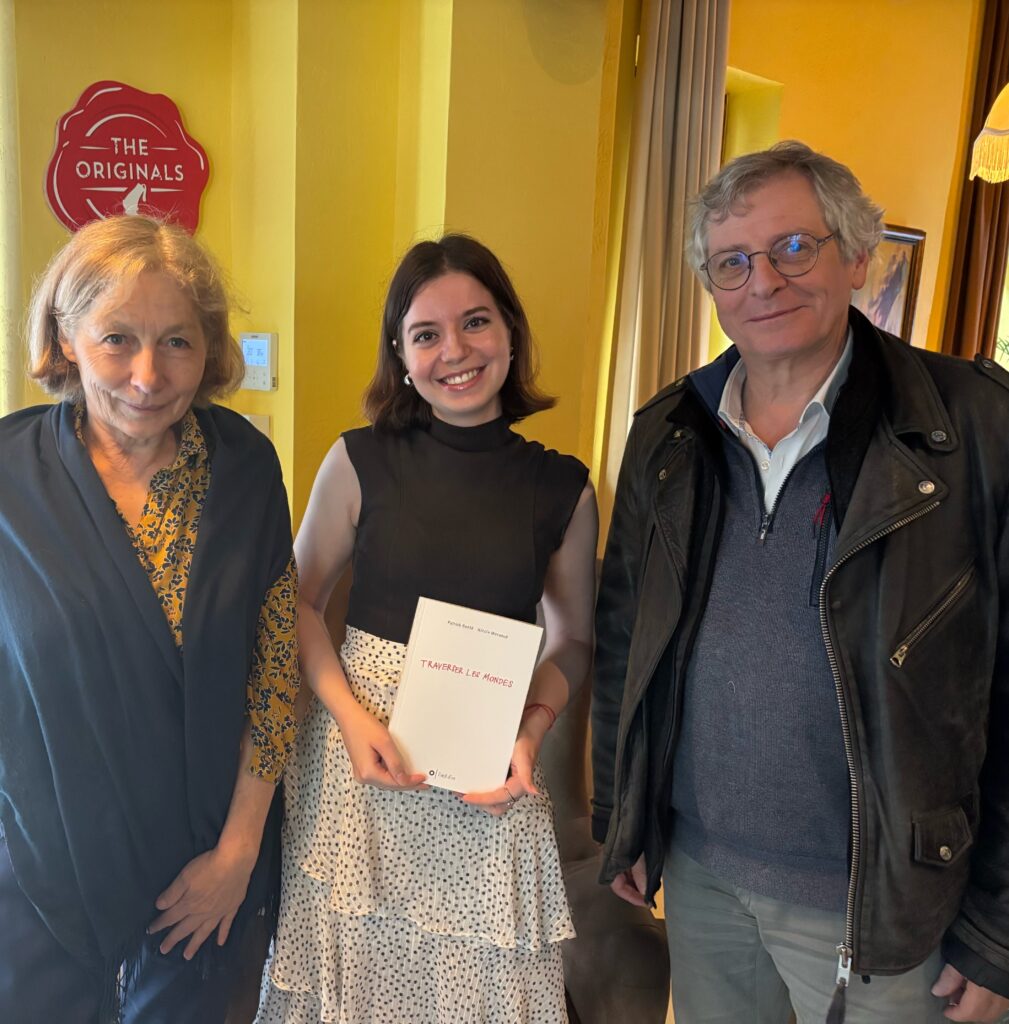
A couple of months ago, Artmedia’s team was on the ground in Craiova at the Shakespeare festival. There, Ivona Iacob had the opportunity to speak to the founders behind the Belgian theatre company Cie Mossoux-Bonté, Nicole Mossoux and Patrick Bonté, about Shakespeare, Ophelia and all matters of how human feelings can be translated, shared and understood through art and theatre. Below, their conversation about the piece they brought to show in Craiova, Ophelie-S, as well as theatre, feeling and how to connect with an audience. (For the French version, please scroll.)
Ivona: Tell us a little about your journey as a theatre company and what ultimately brought you to perform here in Romania.
Nicole: The Company is celebrating its forty years of existence this year with exhibitions, meetings, and presentations of eight different shows. It’s an opportunity to reunite our teams and rebuild connections with people who have worked with us in the past. We already have a long history with Romania, starting back in 2007. We have performed four times at the Sibiu International Theatre Festival, as well as at the Underground Festival in Arad. We also participated in UNIMA meetings in Targoviste.
The Belgian theatre company Transquinquennal, which has been to the Craiova Shakespeare Festival several times, told us how extraordinary this festival is, with all kinds of activities happening throughout the city. Unfortunately, we haven’t had the chance to see much of it, aside from the exhibitions at the National Theatre. For the show Ophelia-s that we are presenting there, we have interpreted the character of Hamlet’s fiancée in a highly visual way, through image and movement. It is a new interpretation of Ophelia—a character who has had many avatars, of which John Everett Millais’ painting is one of the most famous.
Ivona: How do you prepare a show like this, with so many elements to coordinate, from sound and lighting design to the use of water? Where does one begin such a project?
Patrick: We could perhaps say that at the very beginning of our work, we connected over a desire to explore the murky areas of human sensitivity by blending theatrical intentions and developing them through movement and imagery. What is most important to us is to create ways of perceiving things differently, perhaps in a stranger way. We work with dancers, but also with physical actors based on improvisations that we rework until we write a “score”: at that point, the show no longer changes.
The foundation is improvisation. Here, we started from a very specific subject, opening up avenues that we hope go beyond our own personal issues.
“And that’s a great thing, that shows live on in people’s heads, even if they end up completely distorted, that they make them their own story, that they give them a new life in a way.”
I: And how long does that take? How do you know when it’s the finished product you want to present?
N: You can count on up to two years of experimentation with the performers—choosing them first, researching the theme, and then the actual rehearsals. We do foundational stages of work well in advance to find a promising direction, one that is clearly defined yet allows collaborators to bring their own variations to it. Everything starts with an idea, a single point of view that then becomes more complex with the intervention of the performers who, through improvisation, bring us their movement material and their perception of the theme. Then comes the music, the costumes, the lighting.
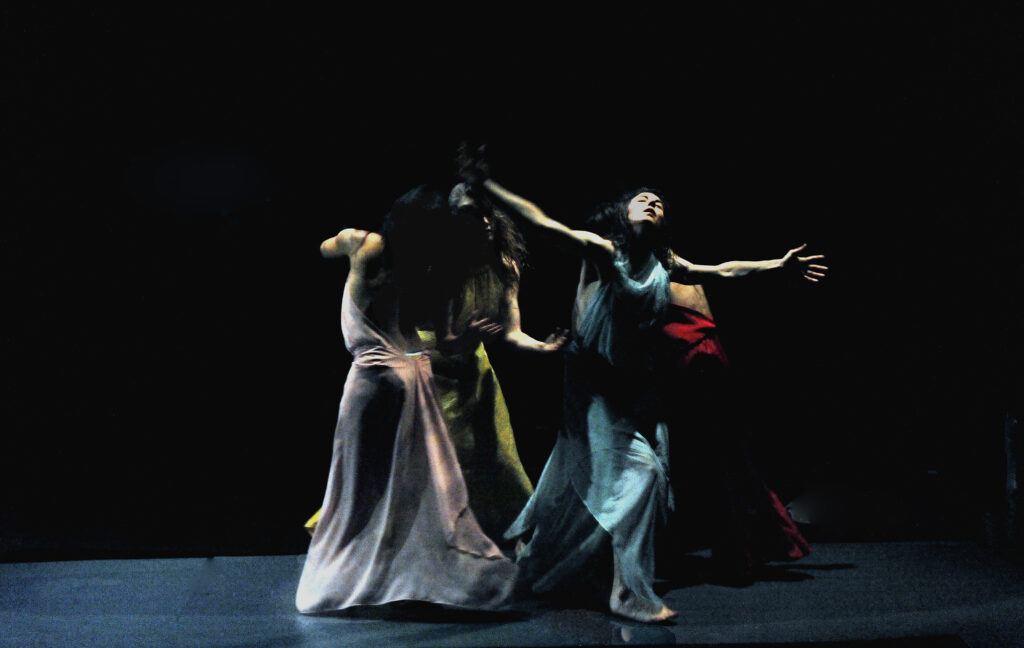
Ophelia’s drowning is the starting point of the play: did she drown by accident, was she pushed into the water, or was it suicide? Four women investigate the death of a woman they identify with, interpreting her through different characters. The play questions the representations of the weakened, submissive, sickly, or dead woman—and all of this beautifully!
The initial intention was to perform the show in a swimming pool. We did some tests there, which ultimately resulted in the film projected during the show. The vision of bodies in the water is much clearer in filmed footage than live at the edge of a pool. With the underwater camera, you can really convey feeling and sensation. On stage, in reality, the characters resonate with the memory of the drowning. That was truly the challenge of this particular show: finding the complementarity between the stage and the video projection.
The women wander along the edge of a pool of dark water, in which they seem to catch glimpses of their own reflection. The screen at the back of the stage reflects their visions—unless it’s their presence on stage that is the emanation of the image. The stage is the reflection of reality, the attempt to act upon it, to modify it. This is where these women are alive, or at least in the memory of an experience, of which the film creates the mental image—Ophelian, melancholic, troubled, caught somewhere in between.
Or, allegorically speaking: on the screen, a submerged valley where traces of life remain within the depths of the waves, while on stage survivors reappear, vivid memories of a place where the water has seemingly withdrawn due to a drought.
I: And what inspired you to choose Ophelia as a reference for this show?
N: Probably because I am a woman! In the company, we alternate projects. One year it’s Patrick, one year it’s me. That’s how we find a creative balance. One puts themselves at the service of the other’s project, and so we support each other alternately like that.
I: What are the challenges associated with taking a show on tour, and what do you think are the advantages of touring with a show?
P: The challenges are mostly technical, and financial. On the other hand, what is very important is sharing issues that mainly concern intimacy and the way we see the world with other people and other cultures. We have often been surprised to see how other cultures, other people react. Shows that we thought would only interest people of European culture, for example, received an unexpected response in Africa or Australia. Ultimately, we have performed on every continent, in 40 countries.
The diverse reception of artworks reveals human richness. We don’t shy away from going into unstable, bizarre, strange areas, but we must be able to turn them into recognizable signs—meaning, we have to make it shareable with everyone. We had a very “telling” experience during one of our very first tours: we performed in Aguascalientes, Mexico, in front of an audience that had never seen contemporary dance. And then, a year later, we performed the same show in Boston to an audience very “in the know” about contemporary dance, and who forgives no naivety. And we said to ourselves after that: we must be able to address both audiences, all audiences, regardless of the spectators’ level of theatrical knowledge, regardless of their psychological, mental, or perceptual habits. At the very least, we must have something that can be shared, meaning we provide a clear sign of it: language is what enables sharing.
Ecological concerns have definitely been weighing on us for a good ten years or so… Is it worth taking a plane? And the only thing that tells us, “no, I believe it is worth it,” is precisely this exchange. How is life viewed in Romania? Or in Japan or Chile? We are very careful not to make trips that are disproportionate to what’s at stake. But artworks need to circulate.
I: And it’s great that even after 40 years there are still things that surprise you while traveling… Do you think that today, Shakespeare’s work, whether in its pure form or through the many cultural adaptations we know, is a way to bridge the gap of “lived experience” with the audience (including a foreign audience or one from a different culture)?
N: Shakespeare’s work speaks beyond eras and cultures; anyone can find food for thought in it. In Hamlet, there are all these degrees of madness clashing, worlds of pure violence. You can also read the absurdity of all this violence, and out of all the characters, perhaps Ophelia is ultimately the most lucid. Trapped in her roles as daughter of, fiancée of, sister, she is aware of her chains, but in the surrounding disaster, she can only exist as herself in death. It’s tragic, but it is her only way of rebelling against the patriarchy, against the laws of men that only lead to catastrophe—everyone ends up dying in this play, after all! She stands out as a free woman; even if later on only her drowning was remembered, she illuminates the entire play with her clairvoyance. She does not let society trap her.
I: And there are always still things to discover.
N: Yes, definitely. We came to Shakespeare through painting, through the multiple representations of his Ophelia. And we often work this way, starting from the visual, and sometimes the visual leads us to the text, and the text finds echoes in movement; the music of the text, the color of the movement—all these elements intertwine. A bit like in an opera, we call upon different trades whose work combines in the show.
We very often work starting from a painting. Perhaps this is somewhat characteristic of our country, steeped in painting for a very long time, particularly Flemish painting. Maybe because we speak two and even three languages there, and since we don’t master them completely, the visual takes over. Our cinema also has a lot of character.
And sometimes images are like words: in John Everett Millais’ painting, every flower surrounding Ophelia holds a meaning, is a symbol. The forget-me-nots mean “do not forget me,” conveying a plea to memory; the poppy symbolizes eternal rest, etc. But the image interests us less for what it might precisely indicate, and more because it asks a question about our gaze itself.
Laura Cadio: Yes, you said that Shakespeare’s theatre flows in our veins, whether we like it or not, and that it secretly nourishes our work as playwrights and choreographers.
N: Yes, we are all somewhat the children of that theatre, which we just interpret differently.
“We feel that it is more necessary than ever to do, to craft forms. If only to enter into a sensitive resonance with the other.”
I: And it’s wonderful when a painting can inspire so many emotions to truly create a show like yours… And in your opinion, what are the specific qualities of dance-theatre that allow it to establish a connection with the audience?
P: We actually speak more of theatre-dance, because we always start from intentions that are then developed through movement. Dance does not come first. But they are dancers; it’s our language taking shape from the desire to develop a theme, to imagine relationships between people, therefore always starting from something that carries a meaning. And it must find a language that allows it to step outside of reality and embrace the fact that the artwork has its own logic. But the starting point is the intention. Which is theatrical, dramaturgical.
I: What do you think the central emotion of Ophelia-s might be?
N: There isn’t a single way to read the play. We have our own images and intentions for building the piece, but it’s not a word-for-word translation, and it can be far from the audience’s interpretation. Spectators can grasp the play—as with all our repertoire, for that matter—without knowing the references that led to its creation. You can watch Ophelia-s without ever having read or seen Shakespeare’s work, but those who know the play Hamlet will be able to find allusions in it, sometimes a bit cryptic, I admit.
The spectator can truly surrender to their own perception, nourished by their own sensitivity, culture, life experiences, and even their psychological state on the day they come to the theatre. The figure of a drowned woman can provoke a flow of very ancient emotions, a deeply rooted feeling within everyone. And each performer lives a noticeably different experience every time they play the piece; it’s an endless story that renews itself every time it faces an audience, depending on the theatres and the countries.
It is said that our shows are highly complex, and people often come back to see them to complete their initial perception. This is often possible because our shows stay on tour for a very long time, sometimes for over twenty years, with new casts. And these span multiple generations; parents bring their children, who bring their brand new perspectives.
If a spectator had the chance to make a 10-year leap between two performances, how would they experience it at those two distant moments in their life? This has led to strange confrontations, like this woman who had seen Twin Houses years prior, who stubbornly insisted that we had changed the choreography of a scene (even though it hadn’t changed one iota, since puppet manipulation requires a lot of precision, preventing any improvisation once the piece is written). She felt betrayed when we assured her nothing had changed. In fact, she had somehow appropriated the scene; her memory had enshrined it in a form that now belonged to her.
And that’s a great thing, that shows live on in people’s heads, even if they end up completely distorted, that they make them their own story, that they give them a new life in a way.
I: Perhaps that’s an advantage of theatre, that you can connect with something different every time you see a show…
N: Absolutely. That is exactly why we call it live performance; it evolves, not necessarily in its form, but in the charge placed into it from both sides: performers and spectators.
I: So you can go multiple times and gain [from it]…
P: We often tell ourselves that the most accurate gaze a spectator can have regarding our shows is the one they have when looking at a painting. Because a painting doesn’t tell the spectator something; it makes them say something. And that is our goal: to awaken an imagination, to speak to the spectator’s imagination, as if what they see on stage is a proposition to go behind the scenes, and behind the scenes lies their own brain and projections. Then they resonate with it or they don’t, they agree or they don’t, or they are surprised, or their impressions are confirmed. But the core goal remains this: to share an imagination.
I: To find interpretations…
P: Yes, yes that, but the spectator is free in that regard. You have to leave the spectator free.
I: And what do you think is the current “to be or not to be” for someone working in the theatre world? That is to say, this sort of existential dilemma on what to do or not to do right now?
N: We feel that it is more necessary than ever to do, to craft forms. If only to enter into a sensitive resonance with the other. To share the shadows, the flaws, the frailties, everything that makes us more human, more specific individually—this is truly paramount in today’s Manichean and “neo-moralistic” world. It is essential to create fictional forms, to make artistic objects that speak freely of our world, and of ourselves in our shortcomings, without false modesty, in the free speech that fiction can constitute. A world where violence, or the feeling of violence, can coexist with all our emotions without causing damage, instead creating reflection. Reflection as a mirror of our thoughts.
Creating signs that are readable for the spectator without imposing a single reading on them, letting them travel through their own imagination via the plays.
And the feeling that this sensitive, fragile, and perhaps clumsy and fallible part of our humanity can have enough strength, formal impact, and “fascination” to reach the other person who is there, lurking in the dark, whom we don’t know. And who doesn’t know us. Our relationship will transition through forms, without affects; we hand the affects over to the artwork, which seizes them and depersonalizes them so they can circulate more freely.
In this way, it is a political act, and the more we touch upon intimacy, the better chance we have of touching the other, the different person—whether by age, sex, or culture—in that inner self where we are all alike, through which we would come together if religious dictates or other potentates didn’t meddle to turn us against one another.
Henri Michaux, our favorite writer, talks about this a lot: about the intimate revealed without betrayal, about the immensity that can open up within oneself. He says “I,” but this “I” is valid for everyone who reads it; it can make another “I” resonate.
Whether we perform in Hong Kong or Craiova, what’s at stake is the same: what will we be able to share that is both intimate and specific, that connects beyond our cultural differences? And here, we have the advantage of not using text, which could act as a barrier.
I: So not to be, but to do…
P: Yes, and then another question regarding “to be or not to be”: right now, it is mostly a financial question. Culture is under attack everywhere. The far right is making a comeback everywhere. Everything that is not commercial is being attacked, and therefore we must do everything we can to defend creation, art, and education.
I: Are there other things you would like to add for the audience? Perhaps you can talk a bit about a project that starts when you return to Belgium?
P: Yes, we actually have a project that questions human relationships today. The violence of relationships, manipulation, predation, everything that is instinctual… We have to address that. What does it do to us? What can we say about it? What does it provoke within us?
We kindly thank Nicole, Patrick and the Cie Mossoux-Bonté team for sharing their thoughts with us.
FRENCH VERSION
Parlez-nous un peu de votre parcours en tant que compagnie de théâtre et de ce qui vous a finalement amenés à vous produire ici, en Roumanie.
N: la Compagnie fête cette année ses quarante ans d’existence avec des expositions, des rencontres et présentations de huit spectacles différents. C’est l’occasion de réunir nos équipes, de retisser des liens avec les personnes qui ont travaillé avec nous par le passé. Nous avons déjà une longue histoire avec la Roumanie, la première fois en 2007. On a joué quatre fois au Festival international de Sibiu, ainsi qu’à l’Underground Festival d’Arad. Nous avons également participé à des rencontres de l’UNIMA à Targoviste. La Compagnie de théâtre belge Transquinquennal qui est venue plusieurs fois au Craiova Shakespeare Festival nous avait raconté à quel point ce festival est extraordinaire, avec des activités en tout genre dans toute la ville. On n’a malheureusement pas eu l’occasion d’en voir grand chose, hormis les expositions au Théâtre National. Pour le spectacle Ophelia-s que nous y présentons, nous avons décliné le personnage de la fiancée de Hamlet de façon très imagée, par l’image et le mouvement, Une nouvelle déclinaison du personnage d’Ophélie qui a connu bien des avatars, dont la peinture de John Everett Millais en est un des plus célèbres.
Comment préparez-vous un spectacle comme celui-ci, avec autant d’éléments à coordonner, de la conception sonore et lumineuse jusqu’à l’utilisation de l’eau ? Par où commence-t-on un tel projet ?
P: On pourrait peut-être dire qu’au départ de notre travail, nous nous sommes rencontrés sur un désir d’explorer des zones troubles de la sensibilité en mêlant des intentions théâtrales et leur développement par le mouvement et par l’image. Ce qui est le plus important pour nous est de créer des voies pour percevoir autrement les choses, de façon peut-être plus étrange. Nous travaillons avec des danseurs, mais aussi avec des acteurs physiques à partir d’improvisations qu’on retravaille jusqu’à en écrire une partition: le spectacle alors ne bouge plus.
La base c’est l’improvisation. On est partis ici d’un sujet très précis sur lequel on a ouvert des pistes dont on espère qu’elles dépassent notre propre problématique.
Et ça prend combien de temps? Comment savez vous que c’est le produit fini qu’on veut presenter?
N: On peut compter jusqu’à deux années d’expérimentation avec les interprètes, leur choix d’abord, les recherches autour de la thématique, les répétitions proprement dites. On fait des étapes de travail bien en amont pour chercher une piste porteuse, à la fois clairement définie et permettant aux collaborateurs d’y apporter leurs propres déclinaisons. Tout part d’une idée, d’un point de vue unique qui se complexifie ensuite, avec l’intervention des interprètes qui , par improvisations, nous apportent leur matière de mouvement, leur perception de la thématique. Ensuite viennent la musique, les costumes, la lumière.
La noyade d’Ophelie est le point de départ de la pièce: est-ce qu’elle s’est noyée par accident, l’a-t-on poussée dans l’eau, ou est-ce un suicide. Quatre femmes enquêtent sur la mort d’une femme à laquelle elles s’identifient, en la déclinant dans différents personnages. La pièce questionne les représentations de la femme affaiblie, soumise, valétudinaire, ou morte, et tout ça en beauté!
La première intention était de faire le spectacle en piscine. On y a fait des essais qui ont finalement donné lieu au film qui est projeté pendant le spectacle. La vision des corps dans l’eau est plus évidente dans l’image filmée qu’en direct en bord de piscine. Avec la caméra subaquatique on peut vraiment donner à sentir, à ressentir. Sur la scène, en réel, les personnages entrent en résonance avec le souvenir de la noyade. C’était vraiment le challenge de ce spectacle-ci: trouver la complémentarité entre le plateau et la projection vidéo. Les femmes déambulent sur la margelle qui borde un bassin d’eau noire, dans lequel elles semblent apercevoir leur propre image. L’écran situé à l’arrière du plateau répercute leurs visions, à moins que ce ne soient leurs présences au plateau qui soient l’émanation de l’image.
Le plateau est le reflet du réel, la tentative d’agir dessus, de le modifier. C’est là que ces femmes sont vivantes, ou du moins dans la mémoire d’un vécu, dont le film composerait l’image mentale, ophélienne, mélancolique, troublée, un entre-deux-eaux.
Ou, d’une façon allégorique : à l’écran, une vallée immergée, où des traces de vie subsistent dans l’épaisseur des flots tandis qu’au plateau des survivantes réapparaissent, mémoires vives d’un lieu où l’eau se serait retirée sous l’effet de la sécheresse.
Et qu’est-ce qui vous a inspiré de choisir Ophélia comme référence pour ce spectacle ?
N: Parce que je suis une femme sans doute! Dans la compagnie, on alterne les projets. Une année c’est Patrick, une année c’est moi. C’est comme ça qu’on trouve un équilibre créatif. L’un se met au service du projet de l’autre et donc on s’accompagne comme ça alternativement.
Quels sont les défis liés au fait de partir en tournée avec un spectacle et quels sont selon vous les avantages de partir en tournée avec un spectacle ?
P: Les défis sont surtout techniques, et financiers. Par contre, ce qui est très important, c’est de partager avec d’autres personnes, d’autres cultures, des problématiques qui concernent surtout l’intimité, la façon de voir le monde. On a été souvent surpris de voir comment les autres cultures, les autres personnes réagissent.. Des spectacles dont on croyait qu’ils n’intéresseraient que des gens de culture européenne, par exemple, ont reçu un retour inattendu en Afrique ou en Australie. On a joué finalement sur tous les continents, dans 40 pays. La réception diverse des oeuvres révèle la richesse humaine. Nous ne nous privons pas d’aller dans des zones instables, bizarres, étranges, mais il faut qu’on puisse en faire des signes, c’est-à-dire qu’on puisse rendre cela partageable par tout le monde. On a eu une expérience très “parlante” dans une de nos toutes premières tournées, nous avons joué à Aguascalientes au Mexique, devant un public qui n’avait jamais vu de danse contemporaine. Et puis un an plus tard, on jouait à Boston le même spectacle devant le public très “au fait” de la danse contemporaine; et qui ne pardonne aucune naïveté. Et on s’est dit après ça: nous devons pouvoir nous adresser au deux publics, à tous les publics, quel que soit le degré de connaissance de la scène des spectateurs, quelles que soient leurs habitudes psychologiques, mentales, perceptives. Il faut qu’on ait au minimum quelque chose qui puisse être partageable, c’est-à-dire qu’on en donne un signe clair: c’est le langage qui permet le partage.
Le souci écologique nous travaille depuis certainement une petite dizaine d’années… Est-ce que ça vaut la peine de prendre l’avion ? Et la seule chose qui nous dit “non, je crois que ça vaut la peine”, c’est justement cet échange Comment est-ce que la vie est vue en Roumanie? Ou au Japon ou au Chili? . On fait très attention à ne pas faire des voyages qui sont démesurés par rapport à l’enjeu. Mais il faut que les œuvres d’art circulent.
Et c’est bon même si après 40 ans il y a toujours des choses qui vous surprennent en voyageant… Pensez-vous qu’aujourd’hui, l’œuvre de Shakespeare, que ce soit dans sa forme pure ou à travers les nombreuses adaptations culturelles que nous connaissons, soit un moyen de combler le fossé de l’« expérience vécue » avec le public (y compris un public étranger ou de culture différente) ?
N: L’œuvre de Shakespeare parle au-delà des époques et des cultures, chacun peut y trouver matière à réflexion. Il y a dans Hamlet tous ces degrés de folie qui s’entrechoquent, des mondes de violence pure. On y lit aussi l’absurdité de toute cette violence, et de tous les personnages c’est peut-être Ophélie qui est la plus lucide finalement. Coincée dans ses rôles de fille de, de fiancée de, de sœur, elle est consciente de ses chaînes, mais dans le désastre ambiant elle ne peut exister en tant qu’elle-même que dans la mort. C’est tragique, mais c’est sa seule façon de se rebeller contre le patriarcat, contre les lois des mâles qui ne font que mener à la catastrophe, tout le monde finit par mourir dans cette pièce, quand même!. Elle fait figure de femme libre, même si ensuite on n’a retenu d’elle que la noyade, elle éclaire toute la pièce de sa clairvoyance, elle ne se laisse pas pièger par la société.
Et il y a toujours des choses à découvrir encore.
N: Oui, c’est clair. On a rejoint Shakespeare par le biais de la peinture, des multiples représentations de son Ophélie. Et on travaille souvent ainsi, à partir du visuel, et parfois le visuel nous mène au texte, et le texte trouve des échos dans le mouvement, la musique du texte, la couleur du mouvement tous ces éléments s’entremêlent, un peu comme à l’opéra, on fait appel à différents corps de métier dont les travaux se combinent dans le spectacle.
On travaille très souvent au départ de la peinture. Peut-être c’est un peu une caractéristique de notre pays, empreint de peinture depuis très longtemps, notamment la peinture flamande. Peut-être parce qu’on y parle deux et même trois langues, qu’on ne les maîtrise pas tout à fait, le visuel prend le dessus. Notre cinéma a aussi beaucoup de caractère.
Et parfois les images sont comme des mots: dans la peinture de John Everett Millais, chaque fleur qui entoure Ophélie relève un sens, est un symbole, les myosotissignifient “ne m’oubliez pas”, traduisant une supplique à la mémoire, le coquelicot symbolise le repos éternel, etc. Mais l’image nous intéresse moins pour ce qu’elle indiquerait précisément,que parce qu’elle nous pose une question sur notre regard lui-même.
Laura Cadio: Oui, tu as dit que le théâtre de Shakespeare coule dans nos veines, qu’on le veuille ou non, et qu’il nourrit par devers nous notre travail de dramaturges et de chorégraphes.
N: Oui on est un peu tous les enfants de ce théâtre-là, qu’on décline autrement.
Et c’est bien quand une peinture peut inspirer autant d’ émotions pour créer vraiment un spectacle comme le vôtre… Et selon vous, quelles sont les qualités spécifiques de la danse-théâtre qui lui permettent d’établir une connexion avec le public ?
P: Nous parle plutôt de théâtre-danse parce que on part toujours d’intentions qui se développent par le mouvement. La danse n’est pas première. Mais ce sont des danseurs, c’est notre langage qui se met en place à partir du désir de développer une thématique, d’imaginer des relations entre des personnes, donc toujours de quelque chose qui porte une signification. Et qui doit trouver un langage qui permette de sortir du réel et d’assumer le fait que l’œuvre d’art a sa propre logique. Mais le point de départ, c’est l’intention.Qui est théâtrale, dramaturgique.
Que pensez-vous que l’émotion centrale de Ophelia-s est peut-être ?
N: Il n’y a pas une voie unique pour lire la pièce.Nous avons nos propres images et intentions pour construire la pièce, mais elle n’est pas mot pour mot, loin de la lecture qu’on aura le spectateur. Il peut appréhender la pièce, comme d’ailleurs tout notre répertoire, sans connaître les références qui ont permis leur élaboration. On peut voir Ophelia’s sans avoir jamais rien lu ou vu de l’œuvre de Shakespeare, mais celui qui connaît la pièce Hamlet pourra y retrouver des allusions, parfois un peu sibyllines, je l’avoue.
Le spectateur peut vraiment se laisser aller à sa propre perception, nourrie de sa sensibilité à lui, de sa culture, de ses expériences de vie, et même de son état psychique le jour où il se rend au Théâtre. La figure de femme noyée qui peut provoquer un flux d’émotions très anciennes, un sentiment très ancré au profond de chacun. Et chaque interprète vit une expérience sensiblement différente à chaque fois qu’il joue la pièce, c’est une histoire sans fin, qui se renouvelle à chaque fois qu’elle est confrontée au public, selon les théâtres, selon les pays.
On dit de nos spectacles qu’il sont d’une grande complexité et souvent les gens reviennent les voir pour compléter leur perception première. Ce qui est souvent possible parce que nos spectacles restent en tournée pendant très longtemps, parfois plus de vingt ans, avec de nouveaux casts. Et ce sont plusieurs générations, les parents emmènent leurs enfants, qui apportent leur regard tout neuf.
Un spectateur aurait l’occasion de faire un saut de 10 ans entre deux représentations, comment le vivrait-il à ces deux moments éloignés de sa vie?
Cela a donné d’étranges confrontations, comme cette dame, qui avait vu Twin Houses des années auparavant, qui prétendait mordicus que nous avions changé la chorégraphie d’une scène (alors qu’elle n’avait pas bougé du moindre iota, la manipulation des marionnettes demandant beaucoup de précision, empêchant toute improvisation, une fois la pièce écrite). Elle se sentait trahie quand nous l’assurions que rien n’avait changé. En fait, elle s’était en quelque sorte appropriée la scène, sa mémoire l’avait sanctuarisée sous une forme qui à présent lui appartenait.
Et c’est tant mieux, que les spectacles vivent dans la tête de gens, quitte à être complètement déformés, qu’ils en fassent leur histoire propre, qu’ils leur donnent une nouvelle vie en quelque sorte.
Peut-être c’est un avantage du théâtre qu’on peut se connecter avec quelque chose différent chaque fois qu’on voit un spectacle…
N: Tout à fait, c’est bien là qu’on parle de spectacle vivant, il évolue, non pas spécialement dans sa forme, mais dans la charge qui est mise des deux côté, interprètes et spectateurs.
Alors on peut aller plusieurs fois et gagner…
P: Souvent, on se dit que le regard le plus juste qu’un spectateur puisse avoir par rapport à nos spectacles, c’est celui qu’il a devant la peinture. Parce que la peinture ne dit pas quelque chose au spectateur, elle lui fait dire quelque chose. Et c’est notre but: susciter un imaginaire, parler à l’imaginaire du spectateur, comme si ce qu’il voit sur scène était une proposition pour aller derrière la scène, et derrière la scène se trouvent son cerveau et ses projections. Alors il entre en phase ou pas, il est en accord ou pas ou il est surpris ou il est confirmé dans ses impressions, mais l’enjeu de meure cela: partager un imaginaire.
Trouver les interprétations…
P: Oui, oui ça, mais ça le spectateur est libre. Il faut laisser le spectateur libre.
Et quel est selon vous l’ être ou ne pas être actuel d’une personne travaillant dans le monde du théâtre ? C’est-à-dire cette sorte de dilemme existentiel sur ce que faire ou ne pas faire maintenant?
N: On a le sentiment que c’est plus nécessaire que jamais de faire, de fabriquer des formes. Ne fut-ce que pour entrer en résonance sensible avec l’autre. Pour partager les parts d’ombre, les failles, les fragilités, tout ce qui nous rend plus humains, plus spécifiques chacun, c’est vraiment primordial dans le monde manichéen et “néo-moraliste d’aujourd’hui. Essentiel de créer des formes fictionnelles, de réaliser des objets artistiques qui parlent librement de notre monde, de nous aussi dans nos travers, sans fausse pudeur, dans la libre parole que peut constituer la fiction. Un monde où la violence, où le sentiment de violence peut cohabiter avec toutes nos émotions sans faire de dégâts, mais créer une réflexion. Réflexion comme miroir de nos pensées.
Créer des signes qui soient lisibles pour le spectateur, sans lui imposer une lecture unique, en le laissant à travers les pièces voyager dans son propre imaginaire.
Et le sentiment que cette part sensible et fragile et peut-être maladroite et faillible de notre humanité peut avoir suffisamment de force, d’impact formel, de ‘fascination” pour arriver à l’autre qui est là, tapi dans le noir, et qu’on ne connaît pas. Et qui ne nous connaît pas. Notre relation transitera par les formes, sans affects, les affects on les livre à l’œuvre qui s’en empare et les dépersonnalise pour qu’ils circulent plus librement.
C’est par là un acte politique, et plus on touche à l’intime plus on a de chance de toucher l’autre, le différent, d’âge de sexe ou de culture, dans ce for intérieur où on se ressemble tous, grâce auquel on se rassemblerait si les diktats religieux ou d’autres potentats ne se mêlaient de nous opposer les uns aux autres.
Henri Michaux, notre écrivain fétiche, parle beaucoup de ça, de l’intime dévoilé sans trahison, sur l’immensité qui peut s’ouvrir à l’intérieur de soi. Il dit “je” mais ce “je” vaut pour chacun qui le lit, peut faire résonner un autre “je”.
Qu’on joue à Hong Kong ou à Craiova, l’enjeu est le même: qu’allons-nous pouvoir partager d’à la fois intime et spécifique qui entre en contact par delà nos différences culturelles, et là on a la chance de ne pas utiliser le texte qui pourrait faire barrage.
Alors pas être mais faire…
P: Oui, et puis une autre question, être ou ne pas être. Pour l’instant, c’est surtout une question financière. La culture est attaquée partout. L’extrême droite revient partout. Tout ce qui n’est pas marchand est attaqué et donc il faut faire tout ce qu’on peut pour défendre la création, l’art, l’enseignement.
Est-ce qu’il y a des autres choses que vous voulez ajouter pour le public ? Peut-être que vous pouvez parler un peu de il y a un projet qui commence quand vous retourne en Belgique?
P: Oui, on a un projet justement qui interroge les relations humaines aujourd’hui. La violence des relations, l’emprise, la prédation, tout ce qui est de l’ordre pulsionnel… Il faut traiter ça. Qu’est-ce que ça nous fait ? Qu’est-ce qu’on peut en dire ? Qu’est-ce que ça provoque en nous ?